Global Service Event Management (GSEM) principles
Definition
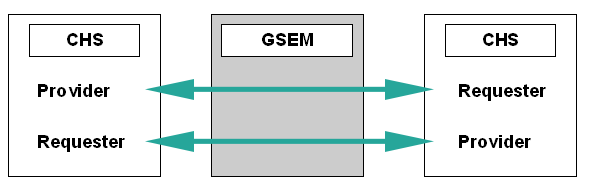
The Global Service Event Management (GSEM) is a capability that allows automatically transmitting Calls between Call Handling Systems (CHS) without manual intervention. Calls are posted by the Requester CHS and received by the Provider CHS. A set of transactions allows creating, updating and calls closing. The GSEM system ensures calls are passed to the Provider and keeps track of the call traffic.

GSEM can handle internal (HPE to HPE) call passing requests and external (Customers to HPE, HPE to Partners) call passing requests through a registration process.
The GSEM implementation is based on industry standards:
-
Service Incident exchange Standard ( SIS ) provides guidelines for:
- Call passing process and data flow
- Call state
- Data structure and content
-
Javascript Object Notation (JSON) for data structure.
-
HTTPS for the transport layer.
Advantages
-
No waiting time, no duplicate work to write call information, avoid mistakes.
-
The right provider is immediately reached.
-
Keeps track of all calls in a centralized system.
-
The requesters send calls to right addresses.
-
The providers get only the requests which are related to them.
-
Calls are passed at once.
Roles
Roles definitions:
Note: GSEM is
symmetric. A CHS can have both Requester
and Provider roles at the same time.